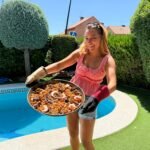
One of my favorite ways to spend the day whenever I go home to Madrid is gathering around the BBQ with my family for paella. Over the years, it’s become a true team effort: my Yaya making her famous fumet (the seafood broth that gives the rice so much flavor), my dad carefully tending the fire to get just the right amount of heat for the perfect socarrat (the crispy layer of rice on the bottom of the pan), and my abuelo cleaning mussels and shrimp before proudly reminding everyone at lunch (at least a dozen times) that the paella tastes so good all because of his mussel cleaning skills.
Like so many family recipes, my grandma never really measured anything. It was all intuition, experience, and a whole lot of love. After years of watching her cook “off vibes,” I finally convinced her to slow down long enough for me to write everything down.
Paella is one of those dishes where every family has their own version. This is ours.
What is Paella?
Paella originated in Valencia, on Spain’s eastern coast, where it began as a lunchtime meal cooked by farmers over a wood fire using rice and whatever ingredients were available. The word “paella” actually refers to the wide, shallow pan, not the rice dish itself.
If you ask someone from Valencia what belongs in a “real” paella, you’ll probably start a debate.
Traditional Paella Valenciana is made with rabbit, chicken, garrofó (similar to a lima bean), saffron, and cooked over an open fire. In fact, many Valencian purists would argue that if it doesn’t follow that traditional recipe, it shouldn’t be called paella at all.
The rest of Spain… tends to be a little more relaxed.
Seafood paella (paella de mariscos), paella mixta (mar y montaña), arroz con cosas (what we call “paella” not made in a paella pan), and countless family variations are made throughout the country. My family has always made paella de mariscos or paella mixta, with plenty of seafood, sometimes chicken, and my grandma’s homemade seafood fumet. It’s the version I grew up eating, and the one I love most.
Tips Before You Start
Choose the Right Cooking Method
If you ask me, the best way to cook paella is outdoors, on a grill, paella burner, or over open fire.
A dedicated paella burner is the gold standard because it distributes heat evenly across the entire pan, but not everyone has one. If you don’t have one, a gas grill is my favorite option and how my family has always made it. It gives you consistent heat, plenty of room for larger pans, and it’s easy to close the lid to help keep the rice covered as it cooks.
A stovetop works too—it just comes with a few challenges. Because paella pans are intentionally wide and shallow, they’re usually much larger than a standard burner. This means the center of the pan gets much hotter than the edges, which can cause uneven cooking. While my grandma has mastered the art of rotation, I have not, so I usually opt for gas grill or arroz con cosas (directly translates to rice with things).
If you’re cooking indoors:
-
Use the largest burner you have.
-
If your pan spans two burners, rotate it every few minutes so everything cooks evenly.
-
Make sure you have a lid or enough foil to cover the entire pan during the resting stage.
Use the Right Pan
A traditional paella pan is wide and shallow, allowing the rice to cook in a thin layer. This is important because paella isn’t supposed to be deep like risotto, NOR is it meant to be stirred.
For this recipe, I recommend:
-
12-inch pan: serves about 4 people
-
14-inch pan: serves about 6 people
If you don’t own a paella pan, you can absolutely use a large skillet, but you may need to cut the recipe in half. Ideally, the layer of rice should stay around ½-1 inch thick.
Don’t Stir the Rice
This might be the hardest habit to break. Once the rice has been evenly distributed, leave it alone.
Unlike risotto, paella should not be stirred while it cooks. Leaving the rice undisturbed allows the bottom to develop the famous socarrat—the crispy, caramelized layer that many Spaniards consider the best part of the dish.
If you like a little extra socarrat, turn the heat up for the final 3-4 minutes. Just listen carefully—you want gentle crackling, not burning.
Build a Good Sofrito
Spanish sofrito is the foundation of the dish.
Typically made from onion, garlic, tomatoes, peppers, and olive oil, it’s where the flavor starts. Don’t rush this step. Let the vegetables soften and concentrate before moving on. It also helps them to release the water content, leading to more concentrated flavor.
The Broth, or Fumet, REALLY Matters
The rice absorbs almost all of its flavor from the broth, so this isn’t the place to cut corners.
Our family always makes a homemade seafood fumet using shrimp shells, fish heads (monkfish head is the best, vegetables, and the briney liquid that releases from fresh cooked mussels. One of my grandma’s favorite little tricks? Add the liquid from a can of mussels to the broth. It gives the rice an incredible boost of savory flavor.
Use the Right Rice
Traditional paella uses Bomba rice, a Spanish short-grain rice that’s able to absorb a tremendous amount of liquid without becoming mushy. If not, another Spanish short-grain rice is your next best option, like Albufero. I don’t recommend using jasmine or basmati rice since they cook very differently and won’t give you the same texture.
Saffron
Saffron is the traditional spice used in paella, giving it its signature aroma and golden color. I like to grind it, then let it steep with ice until the ice melts, to gently coax the flavor out. While traditional and flavorful, it’s also incredibly expensive, so a lot of families (including my grandma), don’t use saffron everytime we make paella. Many families often use Spanish yellow food coloring (colorante alimentario), which gives the rice its classic color without the price tag. This, combined with smoked paprika, also helps give the traditional yellow color.
Use whichever option fits your budget.
Trust Your Instincts
Recipes can only teach you so much, and paella is all about intuition. Taste your broth. If it needs salt, add it. If it needs more tomato, add it. If the rice looks dry before it’s fully cooked, add a little more hot broth. Making great paella is part recipe, part instinct.
And finally, remember that not even every Spaniard knows how to make paella well. It’s one of those dishes that takes practice. My dad, after turning 40, was determined to learn how to make paella and made one per week for almost a year before he nailed it. There’s also so many elements to it and so many ways it could go wrong, so don’t be discouraged if not every paella turns out perfect.
If it isn’t perfect the first time, don’t stress. It’ll still taste delicious. Maybe just don’t invite your in-laws over the very first time you make it.
FUMET RECIPE
The key to a good paella is a good fumet (the broth). This is where you really want to become friends with your fishmonger, because a good fish head or bones can add so much flavor to your broth. You can make this up to 3 days ahead of time, or keep in the freezer for 3 months. This makes about 5-6 cups of stock.
Ingredients:
- 1 tbsp olive oil
- 1 large lean, white fish head (monkfish, snapper, or sea bass)
- 1 lb shrimp heads and shells
- Half a yellow onion, quartered
- 1 large leek, washed and cut into 1″ chunks
- 1 large carrot, peeled and cut into 1″ chunks
- 2 roma tomatoes, quartered
- 4 cloves garlic, crushed
- 2 bay leaves
- 1.5 cups dry white wine
- 4 cups water
- Salt to taste
Directions:
- To a large pot over medium high heat, add the olive oil. Once hot, add in the shrimp shells and cook for 1-2 minutes or until pink. Add the onion, leek, carrot, tomatoes, and garlic, season with salt, and cook for 2-3 minutes. Add in the fish head, bay leaves, and white wine, and bring the mixture up to a boil.
- Once boiling, add the water and a pinch of salt, and cook over medium heat for 30 minutes, stirring often. Taste to adjust for salt, then strain and set aside.
Spanish Paella de Mariscos
- Yield: 6-8
Description
A delicious traditional seafood paella made with homemade stock, fresh seafood, and loaded with flavor.
Ingredients
For the Paella de Mariscos (Spanish Seafood Paella):
- ¼ cup olive oil + 1 tbsp, divided
- 1 lb fresh mussels, cleaned and rinsed
- ¼ cup water or dry white wine
- 1 lb shrimp, peeled and deveined
- ½ lb calamari, cut into 1” strips
- 2½ cups bomba rice (do not rinse)
- 5½ cups seafood stock
- ¼ cup fresh grated tomato (or canned pureed tomatoes)
- 6 garlic cloves, minced + 1 garlic clove, smashed
- 1 sprig parsley
- ½ medium onion, minced
- 3 roma tomatoes, diced
- 1 small guindilla or Anaheim pepper (can substitute for ½ green bell pepper), deseeded and diced
- 3 bay leaves
- 1 pinch saffron, about 10-15 threads (can substitute for 1 tsp turmeric or yellow food coloring)
- 2 tsp Spanish smoked paprika
- Sauce from canned mussels (optional, but the sauce adds a great level of flavor to the dish)
- Salt to taste
For the Quick Aioli:
- ½ cup mayonnaise
- 1 garlic clove, grated
- Juice from ½ lemon
- Salt to taste
Instructions
For the Spanish Seafood Paella:
- Start by prepping the mussels. Add mussels to a large bowl and add enough water to cover. Season with salt and cover to let sit for 20 minutes, to purge the mussels of any excess sand. Drain and rinse.
- To a large pot over medium heat, add 1 tbsp olive oil, the smashed garlic clove, and sprig of parsley. Once shimmering, add the mussels, ¼ cup of water or white wine, and cover. Cook for 4-8 minutes or until all mussels have opened. Discard any unopened mussels. Strain the liquid into a measuring cup and set aside. You should have about ½ cup of liquid.
- To a small bowl, add the saffron, crushing with your fingers to break it up slightly. Add a few ice cubes and let sit to steep as the ice melts.
- Now start on your paella. In a large paella pan over medium high heat, add in 2 tbsps of olive oil. Add the shrimp in a single layer and season with salt. Cook for about 2 minutes per side, until you get some color on both sides of the shrimp. Remove and set aside.
- Add the calamari to the pan with a pinch of salt. Cook, stirring often, for 2 minutes until cooked through, then remove.
- Add 2 tbsps of olive oil to the middle of the pan and add the chopped onions and peppers with a pinch of salt. Sauté for 3-4 minutes or until softened. Add the chopped roma tomatoes and cook for another 3-4 minutes.
- Add in the garlic and cook for 1-2 minutes until fragrant, then add the smoked paprika to toast in the oil and sauteed veggies. After a minute, add the grated tomato and cook for 1-2 minutes or until the liquid has evaporated slightly.
- Add the saffron, seafood stock, liquid from the mussels, and liquid from the canned mussels and stir to combine. Season with salt to taste.
- Increase the heat to high, and bring the mixture to a boil. Add the rice evenly (doing this in a star formation helps to spread the rice out). Use a spatula if needed to gently spread the rice into a single layer, but do not stir.
- Cook over medium high heat for 8 minutes, then reduce the heat to medium low and cover, cooking for 5-7 minutes or until the rice is al dente.
- With about 2 minutes left, while there is still a little liquid left in the pan, arrange the mussels, calamari, and shrimp around the paella pan. If you want soccarrat (the crunchy rice bits), crank the heat up for the last 2-3 minutes.
- When the rice is done, shut the heat off and let the paella sit covered for 10 minutes to allow the paella to rest and finish fully cooking.
- Meanwhile, make your aioli by mixing the mayonnaise, lemon juice, grated garlic and a pinch of salt.
- Serve the paella with lemon slices and aioli.